Monday, February 6, 2017

Shoshana Show and Tell on Sister Corita Kent

Laying the ground rules:


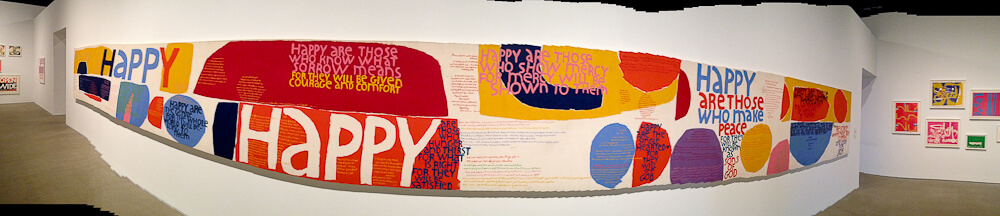
Julie Ault wrote a book about her life and work called: Come Alive! The Spirited Art of Sister Corita

Corita.org houses her life's work.  1964 begins the years of most interest to me.


Anupam's show & tell


Sahmat collective: Art and activism in India since 1989
The influential Delhi-based collective Sahmat has offered a platform for artists, writers, poets, musicians, actors, and activists to create and present works of art that promote artistic freedom and celebrate secular, egalitarian values since 1989.
The collective formed in the weeks after playwright, actor, and activist Safdar Hashmi was fatally attacked by political thugs while performing a street play. In the more than twenty five years since, Sahmat has drawn on India’s secular heritage and an expansive group of collaborators to produce a series of projects that engage in important political and social debates through a mix of high art and street culture.
Animated by the urgent belief that art can propel change and that culture can reach across boundaries, Sahmat has offered a platform for an expansive group of artists and collaborators to present powerful works of art that defend freedom of expression and battle intolerance within India's often divisive political landscape.


Sahmat's projects are defined in part by their consistent stance against the threat of religious fundamentalism and sectarianism—known in South Asia as "communalism"—in public life. Collaborations have cut across class, caste, and religious lines and have involved artists, performers, scholars, and a wide array of other participants, such as the Hindu, Sikh, and Muslim auto-rickshaw drivers in the contest Slogans for Communal Harmony. Projects also have sought to counter political distortions to India's history, most notably in Sahmat's multifaceted response to the demolition of Babri Masjid (Babur's Mosque) in Ayodhya. In other cases, Sahmat has sought to celebrate India's cultural diversity and democratic ideals, engaging artists to create work that responds to ideas of national history and individual identity.

Sahmat Collective: Ways of Resisting

Revitalizing popular culture and personalized ideas of nation. Intervening deep into daily lives of people. Sahmat Collective: Slogans for Communal Harmony

Black book artist statement of Sahmat.

Appropo to Erika's idea about proposing to remove the Statue of Liberty

http://www.dw.com/en/spiegel-editor-defends-trump-beheading-cover/a-37423680

Wednesday, February 1, 2017

Mary Mattingly

Mary Mattingly is a visual artist who's work considers systems, dystopian futures and possible alternative ways of living. Her work is performative, informative, and restorative. 

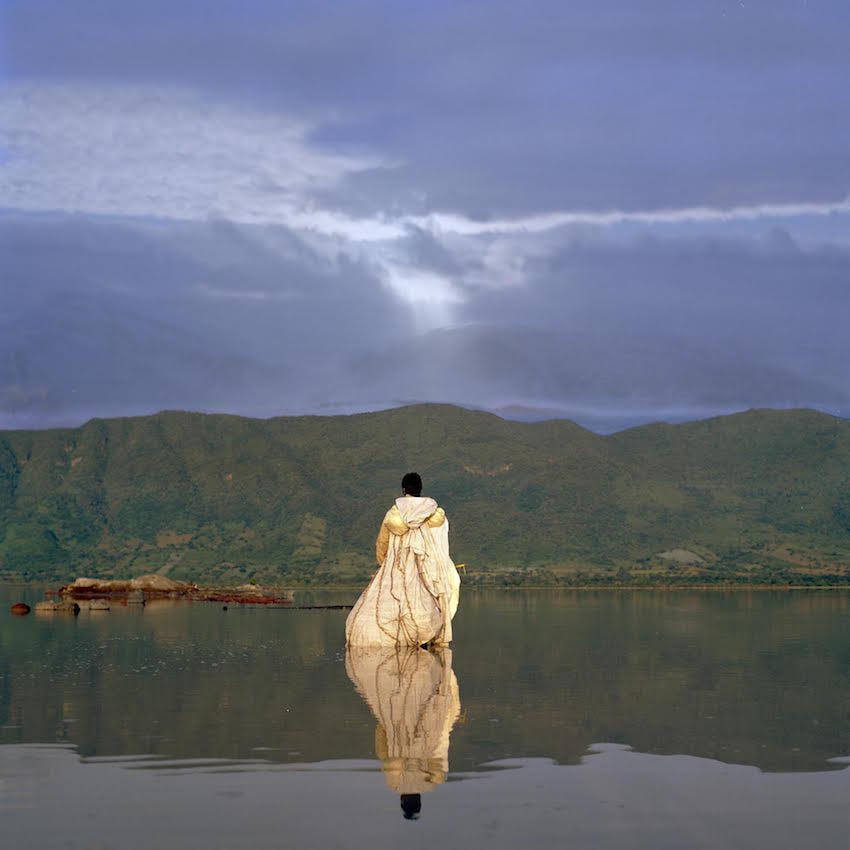
Much of her early work took the form of wearable sculptures with useful functions geared toward inhabitants of a world wherein systems of energy and resource distribution have collapsed. For example, some of these wearable units provide completely-enveloping cocoons for keeping warm at night but can also be worn as clothing, or collect water and store energy. 


In the Navel of the Moon, 2008

Eventually, Mattingly felt that "The dystopic future was very sad to me, and breaking out of that was necessary at some point. I really started to think about my own life and how outside of this future that I was inventing, we all had to live." 

She began to consider ways in which she could delve into her own life and reevaluate her relationship to her belongings and the systems of production, distribution and consumption through which our modern world currently functions. 

Own It  is an ongoing project in which Mattingly is documenting all of her belongings and exploring the means through which they come to belong to her. 


Screenshots taken from OwnIt.org 


Pull, 2013 


Above: Mattingly, pulling all over her possessions, crosses the bridge through which barges enter NYC's largest Port 

While her earlier work imagined possible ways of surviving as an individual in a dystopian future, environmental and economic events in the earlier 2000s, such as floods and water privatization, turned Mattingly's interests toward more communal units. 


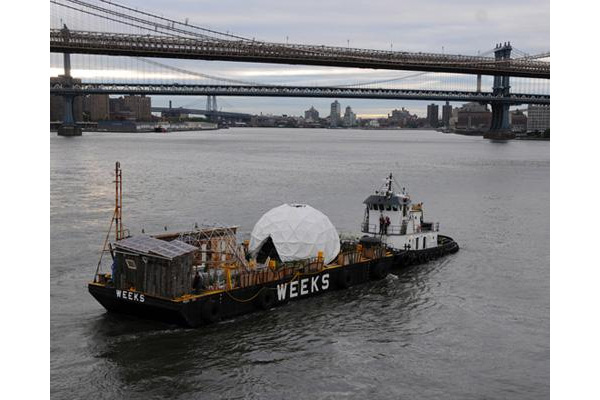
Waterpod, 2009

"The Waterpod demonstrates future pathways for nomadic, mobile shelters and water-based communities, docked and roaming.
It embodies self-sufficiency and resourcefulness, learning and curiosity, human expression and creative exploration. It intends to prepare, inform, and provide an alternative to current and future living spaces.
In preparation for our coming world with an increase in population, a decrease in usable land, and a greater flux in environmental conditions, people will need to rely closely on immediate communities and look for alternative living models; the Waterpod is about cooperation, collaboration, augmentation, and metamorphosis.
As a malleable and autonomous space, the Waterpod is built on a model comprised of multiple collaborations. The Waterpod functions as a singular unit with the possibility to expand into ever-evolving water communities; an archipelagos that has the ability to mutate with the tides.
The Waterpod is mobile and nomadic, and as an application for the future it can historicize the notion of the permanent structure, simultaneously serving as composition, transportation, island, and residence.
As with architecture, art is largely about stories: stories of its inhabitants, its community, its makers and their reflections on the past or expectations of the future.
Based on movement, the Waterpod structure is adaptable, flexible, self-sufficient, and relocatable, responsive to its immediate and shifting environment. 
The Waterpod is an extension of body, of home, and of community, its only permanence being change, flow, and multiplicity. It connects river to visitor, global to local, nature to city, and historic to futuristic ecologies.
With this project, we hope to encourage innovation as we visualize the future fifty to one hundred years from now. This will be the first of many."


Flock, 2012


Flock, 2014

In 2013, Mattingly designed and built a "scalable and amphibious ecosystem" at Pier 42, an area which had been flooded during Hurricane Sandy. 


Triple Island, 2013


House and Universe, 2013 

"For 'House and Universe," I looked at the micro (my personal life and possessions) and the macro (the global supply chain, it's formal and informal sectors.) In a global supply chain, commodity production can be deadly. Extraction of minerals has been known to fuel wars, and it's peoples' desire to consume that is the primary driver of wars like these. I visited different points in the supply chain, from factories to ports and transit points to its end. 

I wanted to turn my useful objects into something very useless so I wrapped them into these big boulder-like forms that really illustrate their mass and obstruction. I made a decision to live my life from now on without them. 

The photographs in "House and Universe" are collages...which are made up of photographs from multiple places and times, re-emphasizing the lack of place-specifity and illustrating their interconnection."


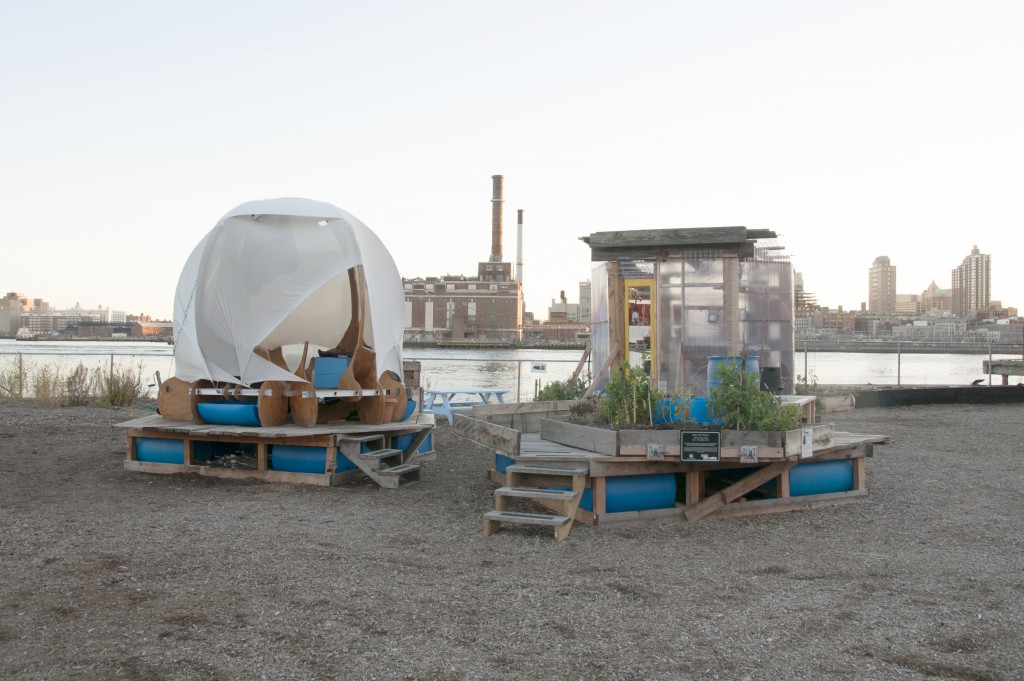
Swale, 2016 and ongoing

Swale is a public space for growing edible plants which are available to the public for harvesting and consumption. It is located on a barge that travels around NYC waterways and docks at different ports to allow for a wide range of public access. 


Sources & Further Information:  


GRAN FURY

Artist activist collective in NYC between 1988 and 1995
Affiliated with and spawned from ACT UP and TAG
Direct political action involved in changing public policy and bringing awareness to the governmental neglect to acknowledge the AIDS epidemic
Worked to help victims of AIDS receive proper medical attention, as well as increase research toward and education about the prevention of and treatment for AIDS
Utilized agitprop and mass media language to infiltrate public spaces with their politically charged messages


'Let the Record Show' at New Museum in NY, 1988


'Pope Piece' for Venice Biennale, 1990


Sticker Lady (Singapore) - Salty wk 4 show & tell

Artist Samantha Lo who previously made stickers of Singapore's "founding father" Lee Kuan Yew as LIMPEH (meaning "your father" in Hokkien -mandarin dialect) pasted subversive stickers on traffic light buttons. Dubbed Sticker Lady, she was arrested and generated interesting dialogue in Singapore about street art.


BEFORE


THE STICKER LADY FIASCO


Police:  "vandalising public property is a very irresponsible act"
Member of parliament: "art per se is not an issue if you get approval"
Appeal judge: while "some might regard graffiti as a stimulating and liberating activity that adds colour, spice and variety to a staid environment", such actions were "offensive to the sensibilities of the general public".

Sparked a public outcry on whether it was art or vandalism.

What could have been a charge for vandalism – which warrants caning and jail time, became a charge for seven counts of mischief. Lo was sentenced to a milder 240 hours of community service as well as a 3 Months Day Reporting Order.


"An art show will only attract a certain amount of people. Even if you put a website up, what makes you so sure people will give a shit about what you are saying?"

She had noticed the limited reach her work achieved and sought for an avenue that will invoke a real and organic response from the masses and not just the selected few.

“I wanted to dig deeper into the issue, how are we affected by everything around us that we’ve become short attention people and having so much information but not knowing what to do with it.” she said.

Given the limitations of street art, Lo was careful and superbly intentional when she designed her stickers. “I used humour, I used Singlish and I used four words. That’s it. And I made it fit into surroundings. I adapted things and made them fit. It had to get people in less than 5 seconds.” she said, explaining why her work’s potency.

With other interviews with the press, she explained that it was her attempt to reclaim spaces for Singaporeans. She expounded on that and said, “I want you to feel like this is home I want you to feel like this is where you belong. I want to use what’s real.”


AFTER

Commissions for tourism spots run by the government


[ In response to concerns if her exhibit would be deemed too local for tourists, Samantha posed the question, “Why should we compromise and cater to tourists?”
“We’ve been doing that for so many years and that’s why everything looks the same. With all this homogenisation, we’ve lost sense of what it means to be Singaporean.”
“And that’s my desire, to bring our identity back,” she concluded, “This is my way of recognising Singapore”.  ]

Solo exhibition 


Article about the fiasco and her solo exihibition some time on-